

School, dignity and a voice in her own life should be ordinary parts of growing up—not privileges a girl must keep proving she deserves.
OPINION / EVIDENCE & PERSPECTIVE · THE DAILY PULSE EDITORIAL

Before asking what a girl will become, we should ask what she is being allowed to choose. Can she stay in school? Can she manage her period with privacy and dignity? Can she speak about the future she wants without someone treating that ambition as a problem?
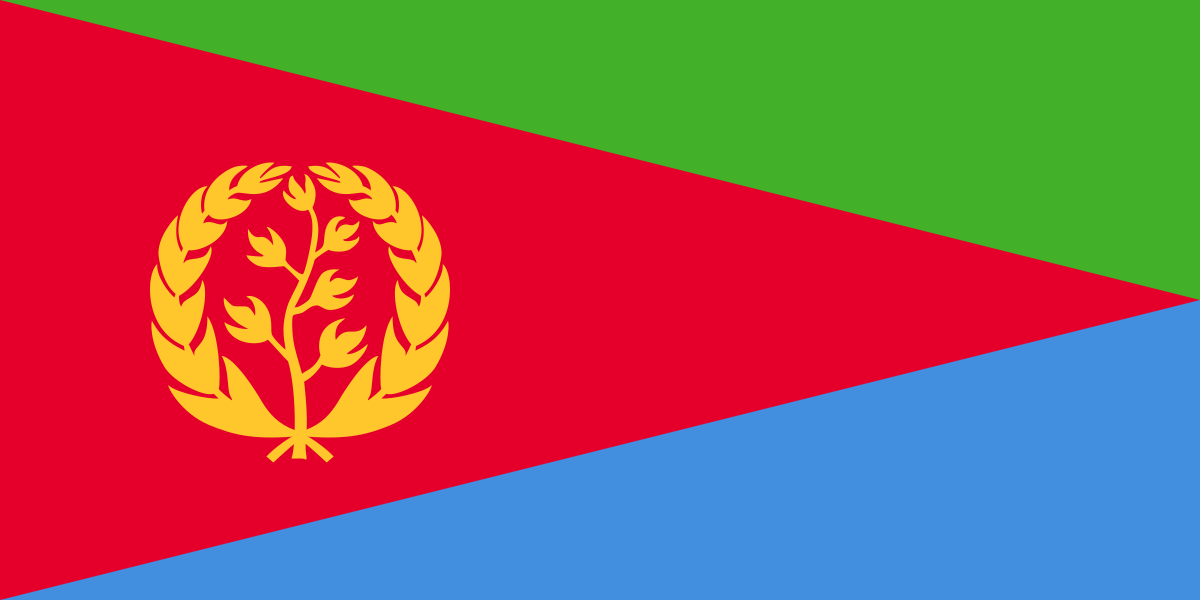
There is no single experience of being a girl in Eritrea. Families, places and opportunities differ. This article is not a girl's first-person testimony, and it should not pretend to speak for every girl. It is an argument that the conditions surrounding childhood deserve as much attention as national policy announcements.
A right must work on an ordinary school day
A July 2022 United Nations account from Eritrea described a menstrual-hygiene programme at Adi-Baro school. It reported earlier gaps in school toilets, then described community construction of facilities and distribution of menstrual-hygiene information with support from Japan, UNICEF and public authorities.
That is a dated example of a practical obstacle and a response—not a current audit of every Eritrean school. Its significance is easy to understand: a right to education includes the conditions that let someone actually attend and learn.
A toilet, water and a place to seek help should not be dismissed as small details beside a national education target. For a pupil, they can determine whether a school day is manageable. Our view is that the quality of an education system must be judged partly through such ordinary experiences.
Protection needs more than a rule on paper
UNICEF's 2026 country-programme document recognises both progress and persistent gaps in Eritrea. It describes national prohibitions on female genital mutilation, child marriage and sexual violence, alongside community efforts against harmful practices. It also identifies social norms and inequality as factors sustaining child marriage, which it links with girls discontinuing school.
Those findings should lead to questions about implementation, not caricatures of an entire people. Who can a girl approach safely? What helps a family keep a daughter in school? How does a community support someone resisting a harmful expectation?
The same document describes improvement in child health while noting unequal access to services in remote and underserved areas. Both belong in the picture. Acknowledging progress does not cancel the work still needed, and naming barriers does not erase the people working to overcome them.
A girl needs a voice, not just a programme
UNICEF describes work with Eritrea's Ministry of Education using school-based adolescent clubs for life skills and expression. This is one example of an approach to participation; its existence does not prove every girl can access it or that all protection needs are met.
The principle matters. A girl should be treated as a person with interests, questions and judgement. Support should create room for her to speak and learn, rather than turn her into an object whose future adults discuss without her.
Institutions should listen in ways that protect children. A public comment box is not a confidential reporting service. Families, educators and authorities need safe, appropriate routes to help, with care around identity and retaliation. We should not ask a child to expose private experiences online to make a story more compelling.
An Eritrean girl's future should not depend on outsiders pitying her. Nor should protecting a country's reputation take priority over listening to her. Respect means truthful attention to difficulty, dignity and possibility together.
The question we leave with is simple: when a girl tells us what she wants her life to become, what are we prepared to change so that she can help shape it?
Sources and context
- UNICEF: Eritrea country-programme document, 2026
- United Nations Eritrea: school menstrual-hygiene programme, 11 July 2022
- UNICEF: adolescent life-skills clubs in Eritrea
Prepared for 7 October 2026 using sources checked on 6 October 2026. This is a source-based editorial, not an on-site report or an interview conducted by The Daily Pulse. Our conclusions are opinion; estimates and institutional accounts are attributed. Where public findings were not located, that limitation is stated.

















Leave a Reply